North Korea has taken another step towards one of its priority objectives: to create an inter-continental missile that is capable of carrying a nuclear warhead and hit accurately the enemy, even thousands of kilometers away.
[subscriptionform]
[level-european-affairs]
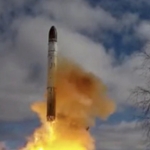
In the last hours in fact, the state media have spread the news that North Korea has successfully tested a new solid-fuel engine that can significantly increase the power of its missile arsenal. The test is part of a larger project, aimed at developing a long-range ballistic missile (ICBM, InterContinental Ballistic Missile), which appears to progress rapidly despite UN sanctions and the numerous warnings issued by South Korea.
After the recent nuclear tests in January, North Korea, therefore, continues to move recklessly on the ridge that divides the bellicose rhetoric against the enemies of the South and the United States and the actual developments in terms of military technology.
The national news agency, KCNA, has proudly hailed the success of the new test, which “has helped boost the power of ballistic rockets,” adding that North Korean engineers will soon be able to test new weapons “capable of striking mercilessly hostile forces “.
Even President Kim Yong-Un attended the demonstration launch, celebrating immediately its success. “This is a historic and memorable day,” he said in front of the microphones and notebooks of regime’s information.
The test actually strengthens the position of Pyongyang after that last week, according to reports by local media, launch and re-entry into the atmosphere of a ballistic missile, that could sooner or later be equipped to carry a miniaturized nuclear warhead, have been tested successfully.
The military tests, once again, was alternated by the rhetoric of provocation. On Wednesday the North has threatened to strike the presidential office of the South with a battery of large caliber rockets, adding that special army units are ready to go into action. South Korean President Park Geun-hye has decided to answer to the attempt at intimidation, ordering to increase the alert level and asking the army to be ready to respond to the “reckless provocations” by Pyongyang.
The tension on the Korean Peninsula therefore backs to rise dangerously, in a time when the Northern regime feels caught between the new sanctions imposed by the UN after the last nuclear tests, and joint military drills that the South and the US are conducting, as every year, at a short distance.
Drills that obviously alarmed Pyongyang, which considers them as “nuclear war moves” to which it must respond decisively.
Despite progress in terms of solid fuel engines, experts believe that North Korea will not be able, for many years, to threaten the United States with ICBMs. Probably part of the verbal and propagandistic escalation of Pyongyang can be connected to internal reasons. Soon it should be held the first congress of the Workers Party of North Korea after 35 years and the current leadership, represented by President Kim Yong-Un, the last of the Kim’s dynasty, needs to bring to the table some important success on the military field to reassert its legitimacy as supreme leader.